The Psychotic Slasher
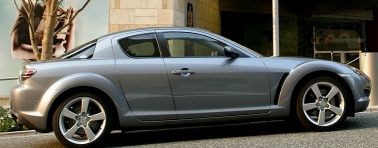
Meet the Mazda RX-8 230 in my life. It develops just under 230bhp (hence the name) and accelerates from 0-60mph in 6.4 seconds1. The car is titanium gray metallic.
1. the only to achieve this being to get to 7000 revs, and drop the clutch.2
2. which will mean you'll soon need either (a) new rear tyres, (b) a new clutch, or (c) both.
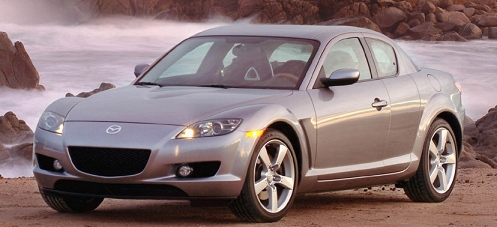 |
No, that's not my actual car. Mine's shinier :-) Plus I would never get it that close to salt water. And the steering wheel's on the wrong side of course. Possibly somewhere in California? |
The RX-8 has a rotary (Wankel) engine with a capacity of only 1300cc. There are two rotors in tandem, each with a capacity of 640cc according to Mazda. But the DVLA in the UK rate it as 2.6 litres, as do most insurance companies. This is because a Wankel engine can generate one power impulse per central shaft rotation: a normal (Otto cycle) piston engine generates one-half of a power impulse per cylinder per crankshaft rotation. You'll note that the SCCA (Sports Car Club of America) defines engine capacity as the sum of the swept capacity (i.e. max cc - min cc) of the cylinders for a conventional engine, but twice that capacity for a rotary engine. This is why.
The only downsides to having a Wankel engine car are (a) having to tell people that, and (b) it sounding like someone left a hairdryer under the bonnet at idle. Otherwise, power delivery is very smooth, interrupted only by the necessity to change gear every four seconds because it's a six-speed relatively close-ratio box. If being that busy bothers you, get the lower power 190 version, which has a five-speed box. The smoothness is because there's very few moving parts in a rotary engine, and those bits that do move are all moving in pretty much the same direction. Did you know that James Watt built a rotary steam cylinder back in the mid 18th century ? For background information on how Wankel engines work, see here (new window).
The car has what Mazda call the "freestyle" door system, actually a very old idea resurrected first in the pickup truck world, and then in this car :
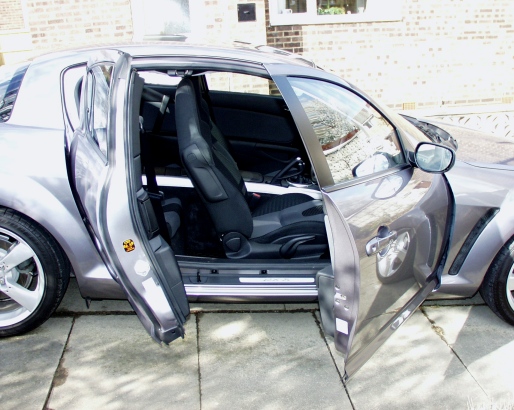
Yes, it has four doors, the rear two opening backwards (yes, this is my car - you can tell because the standard of photography just went down the toilet :-)). It's a lot less trouble for folks to get into the back than a traditional 2+2 with tilting front seats. There isn't exactly oodles of space in the back, but the average Brit fits in OK. Tall folks may have more trouble. For the target market (MX-5 owners who have inadvertantly sprogged), it will do just fine. You can even fit child seats, God help you.
So, what are the pros and cons of owning an RX8, I completely fail to hear you ask ? Here are the things that I've found so far :
Power.
Lots of it, smoothly delivered. The acceleration in second gear is something to experience (if you're in the power band - see below), and devoid of the cacophonous clamour I've grown so used to when pressing on in an MX-5. The lack of torque at low revs makes it a tricky car to drive well around town, but once opened up the car shows its true character. You need to stir that stick, as they say : you need to get used to using all the revs, and changing gear more often than you're probably used to. If you can keep it in the power band, the rewards are great.
This engine and transmission in a car as light as an MX5 would be an experience bordering on the religious :-)
Handling.
Very precise steering - "pointy" and nicely weighted. The handling is very forgiving if you make a mistake. Somewhat more body roll than I'm used to in a 5, but not too bad considering how high I'm sitting by comparison with a 5. You can get improved (third party) sway bars to reduce the roll a little.
Grip (in the dry).
Those humongous wheels and tyres put a lot of rubber on the road. Grip is more than adequate in the dry. Not so hot in the wet though, because the OEM Bridgestone Potenzas are NOT wet weather tyres. You can forget forget ice and snow with these tyres : if your homeland is prone to wintry weather, budget for extra wheels and snow tyres, because you're going to need them.
Equipment.
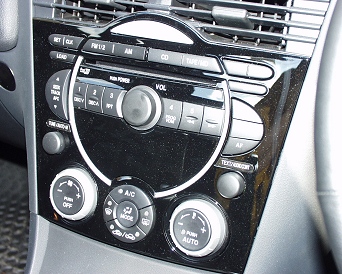
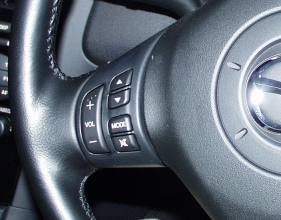
The car is very well equipped for its price bracket, with CD-changer and automatic climate control both standard (UK spec). The only options are DVD/satnav, a sunroof and "leather" seats (actually part-leather). The stereo is not bad at all, considering it's Bose. Nine speakers are fitted. The CD changer is built into this obsessively circularific centre console, and a subset of controls are also on the steering wheel.
 |
 |
Note that the UK standard stereo - as of 2004 - does NOT handle MP3 disks. Norah Jones sounds better in this than she did in the MX5. The finish is a bit plasticky, and it has developed some annoying buzzing noises over the first year of ownership (see below).
Lack of Torque
Rotary engines don't have much low down torque : it's a consequence of the design. Sadly this deprives the car of that "punch in the back" acceleration that the horsepower figures might lead you to expect. It also means that if you get caught in the wrong gear, you're flat-footed: you will have to drop a cog.
Awkward boot.
It has a fairly decent size boot but only because there's no spare tyre, just a temporary repair kit*. But size, as they say, isn't everything. There's an access problem. The boot lid opening is very small, and I struggle to get my golf clubs in as a result. I have to remove my woods, because otherwise the bag won't fit in at all. Usability is also limited due to the huge intrusions made by the rear wheel arches (big wheels = big arches). Those rear seats don't fold, but there's a removable hatch for carrying long items.
* I guess if you have a blowout you have to call your recovery service. A spare tyre is available as an option, but it takes up so much space the boot becomes virtually useless.
Oil Consumption
OK, technical bit here. In a typical piston engine, the oily bits that go round are separated from the bits that go bang. The things that do the separating are the piston rings, and this is why normal engines (i.e, ones that aren't knackered) don't use much oil.
Wankel engines aren't like this. The pistons themselves rotate, and the oily bits cannot be effectively separated from the bits that go bang. The RX8 has what's known as a "total loss" oil system : it continually drips oil into the engine, and the oil gets used up at the rate of about a pint every 1000 miles or so. The upshot of this is that you have to watch the oil like a hawk, because you can run dry, and running a 9000 rpm engine dry of oil would be.... unpleasant. On the positive side, it would at least be a mercifully short experience. Unfortunately, Mazda didn't think this was sufficient reason to fit any kind of electronic oil monitoring system. By the way, that oil pressure gauge on the dashboard isn't a gauge - it's an analog version of the old idiot light, so it only has two settings, OK and About To Seize.
So.... every couple of weeks you have to dive under the bonnet (hood) and yank out the old dipstick. Ugh. Mazda really, really, really need to think of a better way of doing this. Fit some kind of oil reservoir system. And a proper gauge of some sort would seem to be indicated. Apparently Mazda marketing thought this would make it "too complicated"... which only serves to prove that like most marketing departments worldwide, Mazda's is staffed by overpaid pretty idiots.
Because the oil gets consumed by the engine, the car is also very finicky about what kind of oil you use : a low-residue semi-synthetic 5W30 is recommended by Mazda. My dealer uses Shell Helix, but that's VERY hard to find retail, so I use Castrol GTX Magnatec 5W30. Do not under any circumstances use a fully synthetic oil, as replacement engines tend to be expensive... there has been a spate of engine failures in the states because their owners were unwisely advised to use synthetic oil.
Comfort and Ergonomics
One very irritating point against this car is the lack of an adjustable lumbar support : the only way to get one is to shell out 1200 pounds for the electrically-adjustable leather seat option. So that's 1200 pounds for what's actually only part-leather and the need to carry around several additional heavy electric motors ? I don't think so. A small cushion will be cheaper, thank you very much. I expect this kind of gouging from a BMW dealer, but not from Mazda (actually I did get exactly this kind of gouging from BMW, when I was pricing up a Z4. That's about when the discussion ended and I walked out).
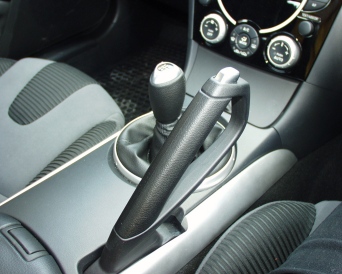
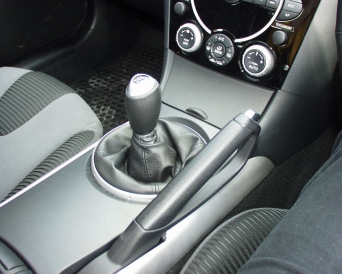
Consider the humble handbrake. One might think that it would be good idea to be able to reach for the gearstick when in motion without banging one's hand into the handbrake, and one would be bloody well right to think so. Sadly this point seems to have escaped the designers of the RX8.
 |
 |
|
| handbrake UP | handbrake DOWN |
That "trigger guard" affair on the handbrake may look cool, but actually it just gets in the way, and the lever as a whole sits too high. I get the feeling this car was designed for the left hand drive marketplace, and right-hand drive was just an afterthought (which is strange, given that the Japanese drive on the left just as we do - but the target market for this car was presumably the USA). A driver on the left would be able to grab the gearstick without reaching over the handbrake. You can't see it in these shots, but there's a bump on the transmission tunnel which intrudes into the driver's footwell, and the pedal positions are a little offset, which also tends to suggest that RHD was indeed a bit of an afterthought.
Note also that the trigger guard doesn't have metal inside the plastic, and when the car interior gets hot in the sun the guard deforms under your fingers in a very alarming way :
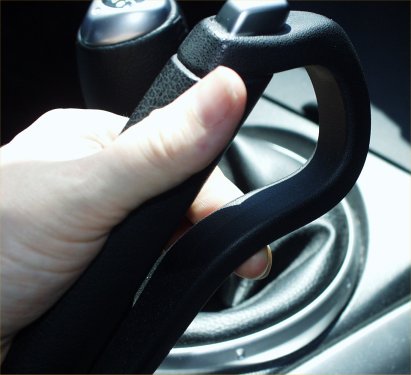 |
| handbrake BENDY |
Unfortunately, materials which get soft when warm also tend to get hard and brittle when cold, which is something I found out a couple of months ago. I applied the handbrake when arriving at work, to discover myself looking down into the transmission tunnel. I forgot to photograph the damn thing before it was fixed under warranty, so you'll have to make do with this indication of the faulty part :
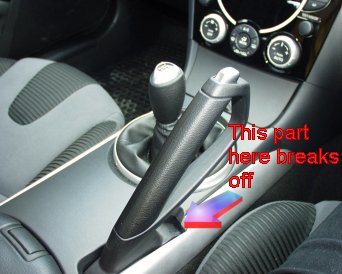 |
The front part of the plastic which covers the transmission tunnel opening (when the brake is applied) fractures and falls into the tunnel. This is a known problem and there's a TSB (Technical Service Bulletin) covering it from Mazda, so your dealer has no excuse not to fix it if this happens to you. The replacement part doesn't get anywhere near as bendy in hot weather, so I suspect this fault is permanently fixed.
Visibility
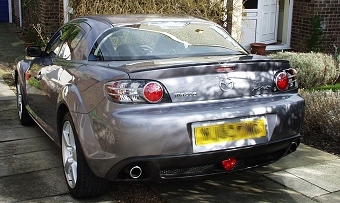 |
Rearward visibility is diabolical, thanks to that high tail, thick C (B+?... whatever) pillars and relatively small rear window. The 5 was a doddle to reverse, whereas this is nerve-wracking. If anything makes me give up on this car, this will be it. I've completely given up backing into parking slots, it's just beyond me. Rear 3/4 visibility is also not so great. I find myself relying upon the mirrors much more than I did in the 5. Mind you, merging at motorway junctions is much less hassle when you have this much power on tap. |
Scary
Can be a bit scary to drive if you're not used to a lot of power. If this is 230 bhp, I find it hard to understand folks who drive 350+bhp cars (though most of them have big hefty V8 lumps to carry around, so the bhp/ton figures are probably comparable. Note to self - look into this theory). I can get wheel spin in a variety of gears, and have had the back end step out twice within three days of taking delivery. I had to provoke the back end in the MX5 - not so with this baby. But it's actually less of a shock in the RX when it does kick out: it's easy to catch, easier than the 5, and that's one of the best handling cars in the world. This is probably due to the DSC, but I haven't had the guts to try switching that off yet.
Thirst
22-24mpg combined (my journey to and from work is half motorway, half A road, some junctions, so it's a reasonable comparison). I suspect a lot less when trying hard. That squares with the U.S. experience, where they were seeing 18mpg or less, but of course their gallons are smaller than ours. Rotaries are known for their thirst, and this beast is no exception. 22mpg and 80% tax on the fuel..... did I mention that I hate the Chancellor ? I may not have said that today.
Insurance
It's rather heavy : Group 16-17. I had to shop around and take a 500GBP excess to achieve a sensible premium, and that's at age 44 with a clean licence, 22 years experience and more than 10 accident-free years behind me. The young and inexperienced need not apply. On the other hand, the Nissan 350 is typically group 19, so I dodged a bullet there.
Brakes
Digital, i.e. they're either on or off. Abrupt is not the word here, they are extremely powerful. Brakes like these work well on the track, but around town they tend to snatch and you'll see your passengers heads bobbing backwards and forwards.
Tyre Costs
Servicing is relatively cheap (rotaries are mechanically simple), but tyres are NOT cheap. This car has 225/45 r18 tyres all round, the same size as a Jaguar XK, and to replace each of the Bridgestone RE040 OEM tyres typically costs over 200GBP, i.e. I could almost re-tyre the whole MX-5 for what it costs to shoe one corner on this thing. Fortunately if you go a tad down-market you can rapidly reduce that : cheapo ones are in the 110 range, the Pirelli 6000 tyres I had on the 5 are around 140GBP in this spec.
Feel
Despite the power and the decent handling, it doesn't feel like a sports car, certainly to someone coming from an MX5. I suspect this may be because the seating position is so much higher than the five : it almost feels sit-up-and-beg to me. This will of course not bother you if you're coming from a saloon (sedan) car, because you'll be sitting lower than what you were used to. There's also quite a lot of body roll when cornering, despite the fact that the roadholding generally is very good - it just doesn't feel that way.
Buzzes and Rattles
After a year or so, I find on long journeys that I hear strange noises in the cabin - odd buzes and rattles that I can't localise. There's often a rattling from the driver's door, but of course it won't repro on demand, especially when the dealer's service manager is inside the car.
Conclusion
 |
It's a lot of bang for the buck, but I can't help thinking I'd rather have a larger boot and a spare tyre than the two extra seats. I guess I'm not the typical RX8 customer. Eventually, the huge fuel consumption, oil maintenance issues and tiny boot got the better of me. I traded it in for a Ford Focus ST3. |
Back to Your Host